

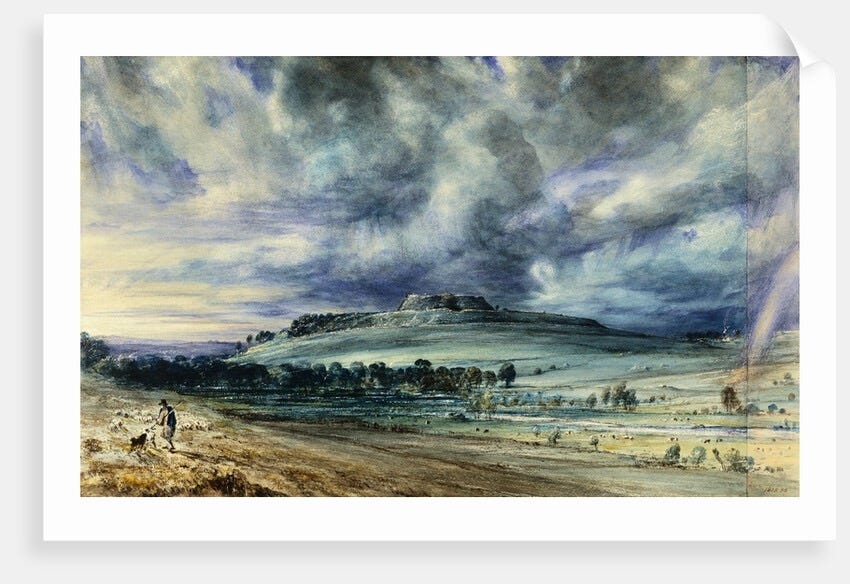
Art Work of the Week — John Constable, Old Sarum (1834) — A small Constable I keep returning to in late spring: a Wiltshire hilltop that was once a cathedral city, now grass mounds and weather. Constable painted it as if the storm light were doing the disclosing — as if what stood there, even centuries after withdrawal, could still be made visible to a patient eye. Old Sarum was abandoned by the thirteenth century; the cathedral moved down to Salisbury. By Constable’s time there was nothing on the hill but earthworks and sky. The picture is what is left when a place stops being a place. It feels like the right April companion to Palmer’s Shoreham garden from last month — the same English visionary tradition, but turned the other way: not blossom suddenly disclosing the spring, but a hill quietly disclosing what it no longer holds.
An article that made me think — The Clearing, Little Toller’s online journal — Not Katherine May’s Substack of the same name, but the online journal from Little Toller Books — the publishers who keep Adrian Bell and Edward Thomas in print. The Clearing runs essays on landscape and place; this week I have been working through a back catalogue of pieces on shadow archaeologies — deserted medieval villages, drowned valleys, the residue of estates whose great houses have gone. What strikes me is how persistent the trace remains. Centuries after a demolition, the lawn lies differently over the foundation. An avenue’s poplars hold the line of an arrangement no longer in force. The world withdraws but the geometry stays.
Something I learned this week — the word Verbergung — The pair to last month’s aletheia, and the word I have been turning over while drafting a new poem. Verbergung is Heidegger’s name for concealment — what the earth does, the way ground always closes itself, withdraws, refuses to be brought fully into the open. Where aletheia is the un-forgetting that lets a thing show up, Verbergung is the prior withholding that any disclosure depends on. Nothing comes into the open except against a withdrawing. The grass closes over the foundation. The hawthorn stands at the hedge-line of a field that used to be a kitchen-garden. We are quicker to celebrate disclosure than to credit the withdrawing that makes it possible — but the two are one motion.
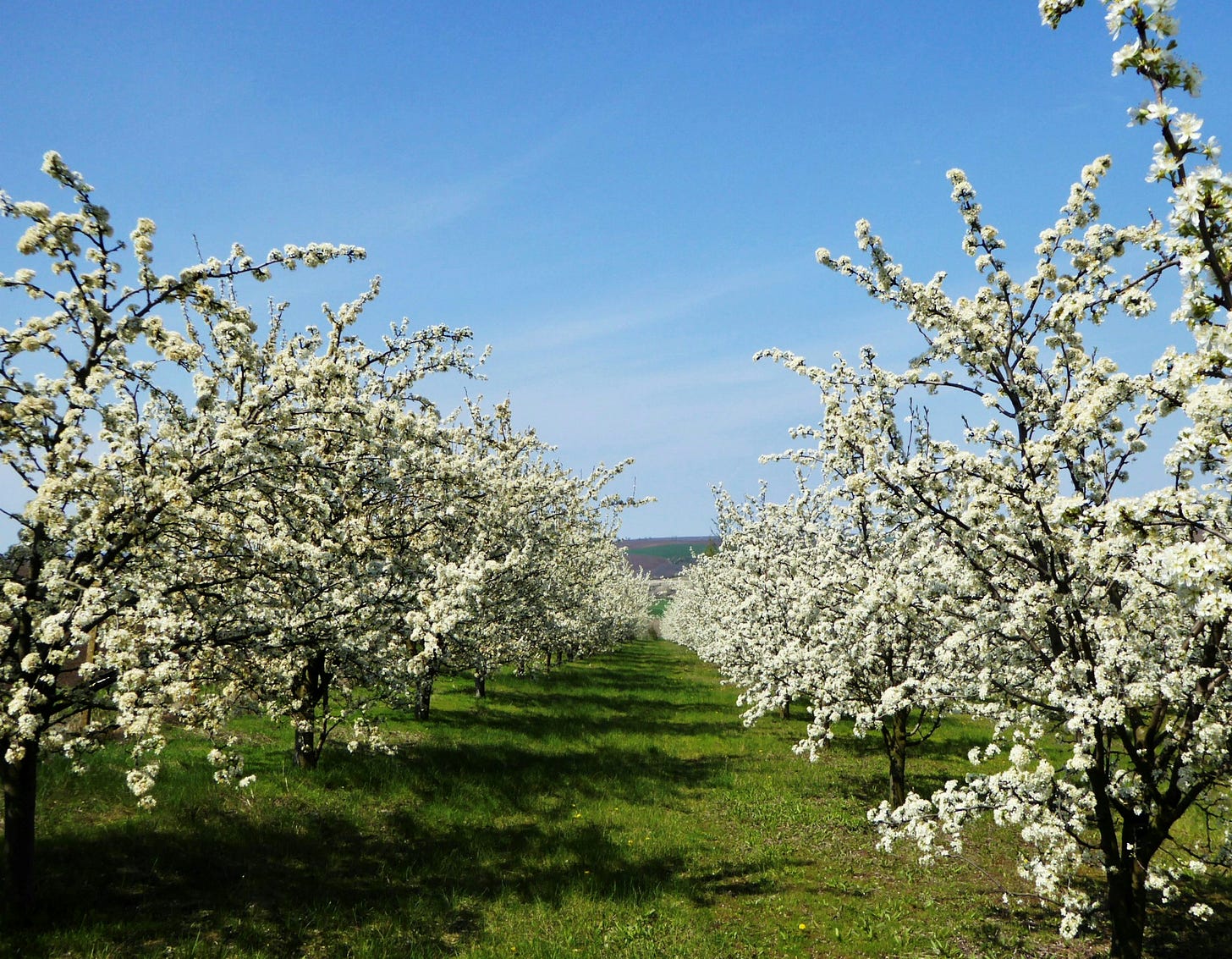
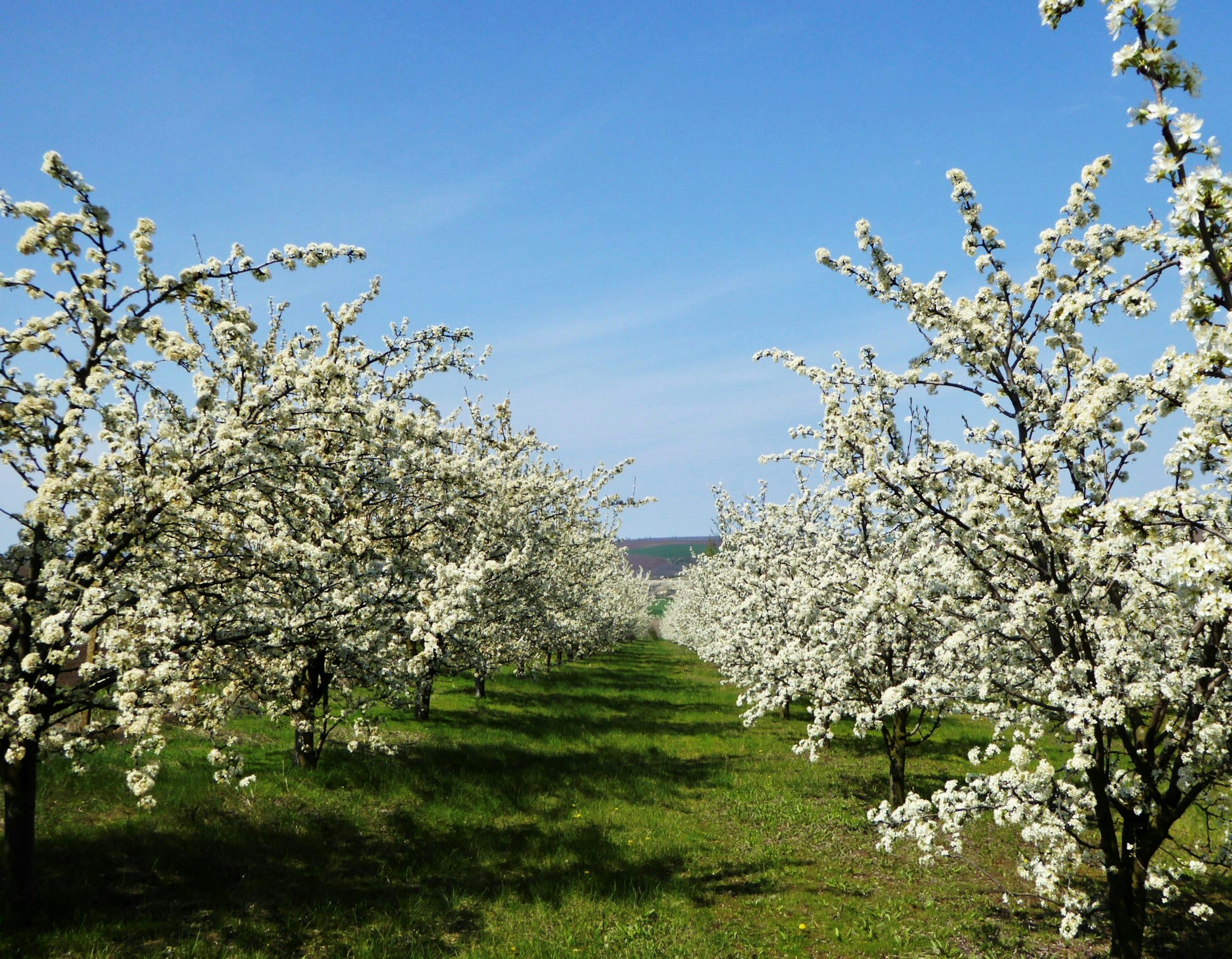
Something happy — the Herefordshire orchards in blossom — The blossom this week has been improbable. Walking the lanes, the perry pear and apple orchards are at their height — a soft, not-quite-white shock that lasts maybe ten days each year if the wind holds. There is a particular, very English sound to a heavy bee in heavy blossom — a low, focused, drowsy hum — which I would not know how to describe in any other terms. Traditional orchards are themselves a quietly disappearing landscape (Herefordshire has lost most of its old orchards in the last fifty years), so the blossom carries its own small Verbergung — what is here, while it is here, against a long withdrawal.
Where I found hope this week — the work itself, again — The Verve Poetry Press pamphlet deadline fell at the end of April, with Cinnamon and the Brotherton Prize gone earlier in the spring. After another quiet phase of editorial work — a different selection, a different running order, a smaller pamphlet built around the working-landscape poems — there is the strange clean feeling that follows submission. Not optimism about the outcome, which is out of one’s hands, but the steadier thing: the satisfaction of having brought something to the state where it could be sent. The labour of attention, again, rearranges something. The work moves on.
Something inspiring — Alice Oswald — I have been re-reading Dart, Oswald’s book-length poem about the river Dart in Devon. It is built from years of recorded conversations with people who live and work along the river — bailiffs, swimmers, walkers, a forester, a ferryman — collaged into the river’s own voice. What inspires is the discipline behind it. Oswald spends real time with a place before she lets it speak. She was a previous Professor of Poetry at Oxford, and her public lectures, recorded and freely available, are among the best contemporary instruction in attention I know.
A poem to enjoy — Wilfrid Gibson, Flannan Isle (1912) — Gibson is a Dymock poet — Edward Thomas’s circle, a few miles from where I write — and an unfairly forgotten one. Flannan Isle is his best-known piece: a relief crew arrives at a Hebridean lighthouse where three keepers have vanished, leaving behind a half-eaten meal, an unmade bed, an upended chair. It is Verbergung in a small ballad — the world withdrawing inside an ordinary domestic scene, presence read entirely from trace. As, on the threshold, for a spell, / We paused, and listened to the swell. I have been working on a response poem to one of Gibson’s lyrics this week, and finding more in him each time.
A Substack to savour — Patrick Laurie, And the Yellow Ale — A different register from Katherine May (who I featured last month) — Laurie writes from inside a working farming year in Galloway, where he raises native cattle and watches the land change. His recent piece And the Yellow Ale is a good way in — plain, fluent prose with the authority of someone who actually does the work, holding the byre and the weather and the small evening particulars in the same hand. He is the author of Native: Life in a Vanishing Landscape — about beef cattle, peewits and what custodianship actually looks like — and the Substack is the same voice continued in shorter form. Read alongside May, the two registers triangulate where I keep finding myself: attention as practice, in places that are quietly going.
Music I enjoyed this week — Vaughan Williams, Pastoral Symphony (Symphony No. 3) — Not the Lark Ascending — though I have nothing against it — but the third symphony, composed between 1916 and 1921, in long quiet thought after Vaughan Williams’s war service in France. It sounds pastoral. It is, and it isn’t. The composer wrote, late in life, that it was “really wartime music — a great deal of it incubated when I used to go up night after night with the ambulance wagon at Ecoivres.” The music is the country those men were fighting for, and an act of mourning for them. Sixty-five minutes; four movements; the soprano in the finale rising over a wordless landscape. Best heard quietly, with low light and the windows open.