

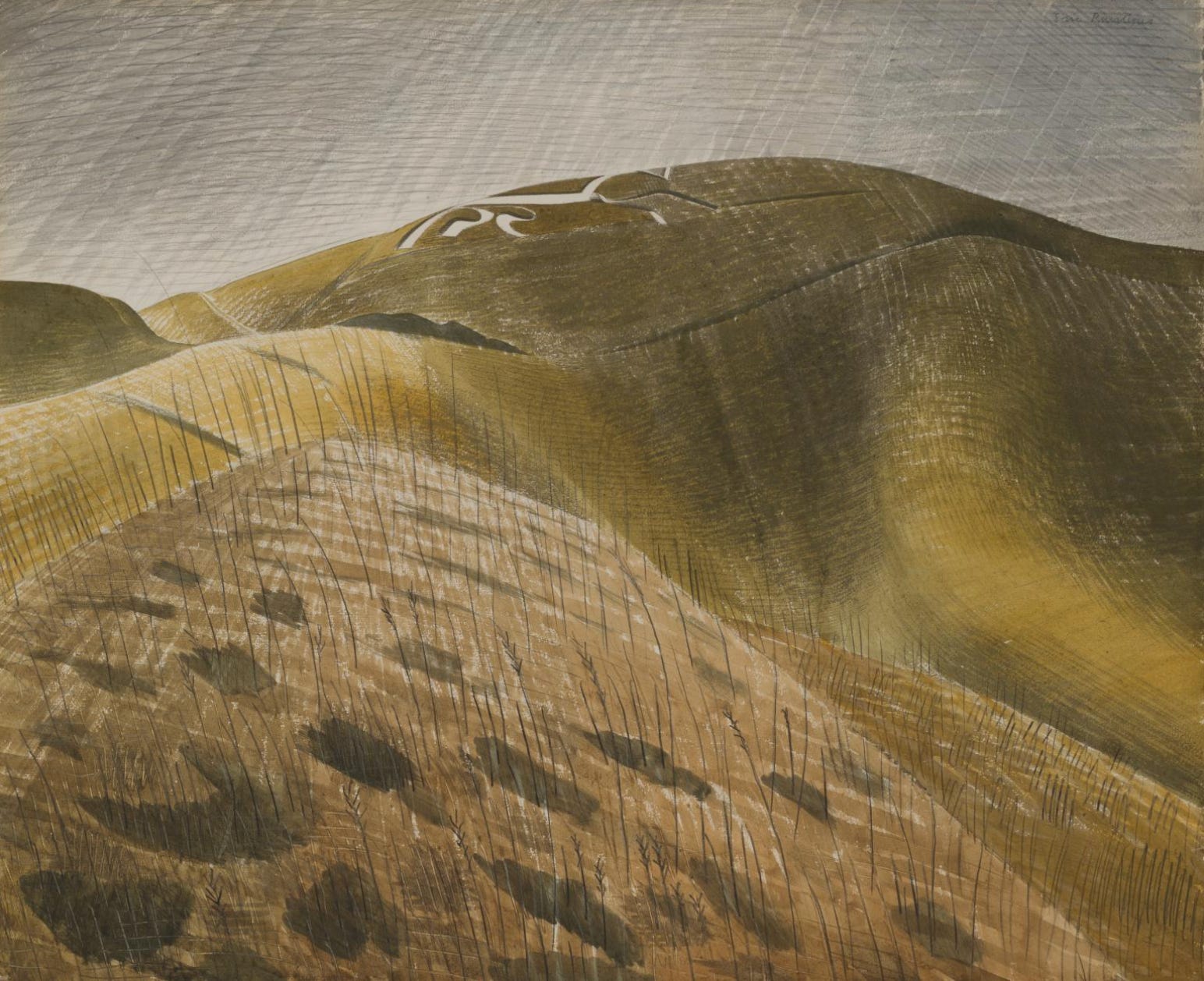
Eric Ravilious, THE VALE OF THE WHITE HORSE c. 1939
We are ten days or so from the solstice, the hinge of the year — the cow parsley gone over, the elderflower out along the lanes, the swifts at full scream round the eaves until past nine.
Everything this week is at its absolute height, which is also the precise moment it begins to tip. All three of this week’s finds were made by people who seem to have known that.
1. A poem to enjoy — Edward Thomas, “The Glory” — Back to the Dymock poets after a spring away from them, and to the one who haunts me most. The Glory opens on exactly this season — The glory of the beauty of the morning, — / The cuckoo crying over the untouched dew — and then does something braver than praise: it admits the speaker cannot be equal to the day. He tries to name the glory, fails, and turns the failure into the poem. It is the truest thing I know about high summer — that the fullness is precisely what you can’t hold, can’t “snare,” can’t carry home — and Thomas, who would be killed at Arras two years later, knew the cost of the things that won’t keep.
2. Art work of the week — Eric Ravilious, The Vale of the White Horse (c.1939), Tate — Staying with the chalk that ran under last month’s Paul Nash: here is the Uffington White Horse, seen from below and through falling rain, the oldest hill-figure in Britain cut into the down three thousand years ago and kept legible only because each generation has gone up and re-scoured it. Ravilious returned to these downs his whole short life; he painted this in the last summer before the war, and was himself lost off Iceland as a war artist in 1942. The horse is the thing the painting is really about: attention made permanent in turf, a shape held in the land only because people keep choosing to look after it.
3. Music I enjoyed this week — George Butterworth, The Banks of Green Willow (1913) — Six minutes that are, to my ear, the most perfect English idyll ever written: a small orchestra, a clarinet taking up a folk tune Butterworth had collected in the field in 1907, and a summer afternoon that seems to hang without moving. It was premiered in early 1914 by a 24-year-old Adrian Boult. Two and a half years later Butterworth was shot by a sniper on the Somme, his body never recovered, his name on the Thiepval Memorial. You can hear the whole of an England in it that he must have half-known he was about to lose — which is perhaps why it sounds less like a celebration than like someone looking very hard at something while it is still there.
A question for you — what is your signal that the year has reached the top and started down again? Not the calendar solstice but the real one: the first cut hay, the elder coming out, the evening you notice the light has stopped getting longer. Reply and tell me — I read every one.
A thought from me — three makers, a poet, a painter and a composer, all circling the same fact: that the fullest things are the ones that won’t stay, and that the only honest response is to look while they’re here. Thomas couldn’t snare the morning; Ravilious’s horse survives only because someone keeps re-cutting it; Butterworth’s idyll holds an afternoon that was already going. Attention, it turns out, is the one form of keeping we’re actually allowed. The solstice is a good week to practise it.
Thanks for reading Beyond Solitude!
I had never heard of Butterworth and I suddenly deeply mourn the missing. Thank you.