

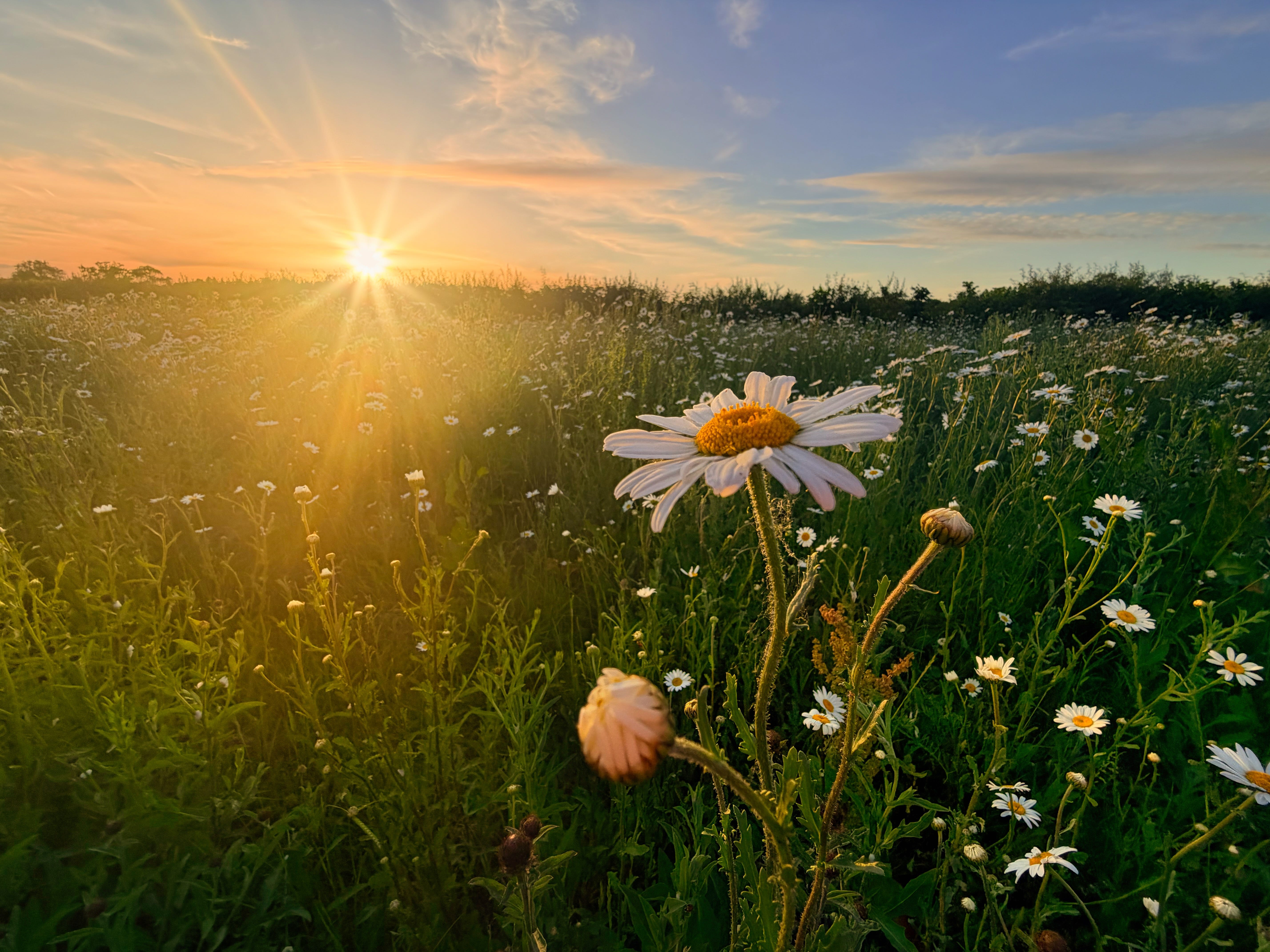
Oxeye daisies in the field outside my window - Adam Cairns, 2026
There is a quality to the heat this summer that I have started, against my better judgement, to read as mood. It isn’t the heat of a good July — the kind that dries the hay and fills the orchard with wasps and sends everyone, sensibly, into the shade by two. It is a heavier thing than that. It sits on the fields the way a bird sits on a clutch of eggs: close, patient, unwilling to be moved. My garden is barely a garden yet — a square of new turf laid last autumn, the soil under it still builder’s soil, a blank green canvas I have not begun to make anything of. But it looks out onto fields, and between the lawn and the farmland there is a strip of wildflower meadow, and even in this heat the meadow is doing what the meadow does: oxeye daisies gone slightly papery at the edges, vetch scrambling through the grass, a dozen things I am still learning the names of, all of it loud with something at every hour of the day. Beyond it the ground under the far hedge has gone the colour of ash. The buzzards still work the field margins in the long evenings, but low, and without much conviction, as if even they can feel the thermals have turned against them.
To brood is to sit on eggs and keep them warm until something living comes out of them. It is also what we do with a worry that will not leave — we brood on it, we turn it over, we let it heat. The word carries both, and I have caught myself this summer thinking the two meanings have quietly fused. The planet is brooding. It is warmer than it should be, held at a temperature it did not choose, by us; and what is incubating under all that patient heat is not, any longer, only life. It is something closer to grief.
I am wary of writing sentences like that. The register of the ruined planet is a register I distrust, in myself most of all — it flatters the writer, it makes weather into portent, it borrows a grandeur that belongs to the thing and not to the person describing it. So let me stay with the particular, which is the only ground I trust. The papery daisies. The vetch. A blackbird panting in the shade of the fence with its beak open, doing the only thing it knows to do about a heat it has no name for. These are small facts, and they are true, and they are connected to each other and to a hundred thousand things I cannot see, by a web so fine and so total that we have only lately, and only partially, learned to notice it is there at all.
That is the thing that stays with me. Not the heat itself, but what the heat reveals: that nothing out there is alone. The oxeye depends on the hoverfly and the hoverfly on the aphid; the swift depends on the column of insects that rises off the warm grass at dusk, and the insects on the damp the drought is taking away; the oak in the far hedge feeds the jay and the jay plants the oak, and under all of it the mycelium moves sugar and warning from root to root in a traffic we are only beginning to eavesdrop on. It is relation all the way down. That meadow is not a patch of separate flowers; it is a conversation, and an old one. To stand at my new fence in the heat and look at it properly is to understand that solitude, out there, is not the human condition or any condition at all. It is simply not on offer. Everything is holding hands with everything else.
Everything, that is, except us — and here I have to be careful again, because it isn’t that we stand outside the web. We don’t. We are in it up to the neck; we eat it and drink it and breathe it. It is that we are the one strand of the web that can see the whole of it, hold a picture of it in mind, grasp what it costs to pull a thread — and pull the thread anyway, out of wastefulness, out of appetite, out of a kind of species-wide capriciousness that treats the whole intricate apparatus as a backdrop to our own weather. We are the only creature that could choose, and mostly we choose the way you choose to leave a light on in an empty room: not out of malice, out of not-quite-attending. That is the part that keeps me up in the heat. Not villainy. Inattention, at a planetary scale.
I came to this house last autumn, out of an older and harder-worn one — the house where a marriage ended, where the worst of the dark years were sat through, where I had also, in the slow way these things happen, tried to build a life among people I hadn’t chosen and a town I didn’t yet know. Some of that took: a climate group I gave a couple of years to, a handful of good people, the hard yards of arriving somewhere as a stranger and asking to be let in. I left the group behind with the house. What I did not leave behind was a thing one of the older men there said to me once, almost in passing, about the curlew — that a bird can go from common to gone inside a single working life, and that the last of them do not know they are the last. They simply call across a field, in spring, and wait, and nothing calls back.
That is the solitude I did not have a name for until this summer. Not the solitude a person enters on purpose and leaves in the afternoon to go and be among people — the door, not the wall, that this whole newsletter has been trying to describe. The curlew’s is a different order of thing. To be the last of a kind, calling into a field that has forgotten how to answer, is the only true solitude there is, because there is nothing on the other side of it to pass through into. Extinction is solitude with no morning after it. And it is precisely that — the final, unpassable version of the thing I have spent two years insisting is only ever temporary — that we are, uniquely and at speed, manufacturing for the curlew and the lapwing and the eel and the swift and a long, lengthening list of our neighbours on this warm rock, most of whom we will never trouble to learn the names of.
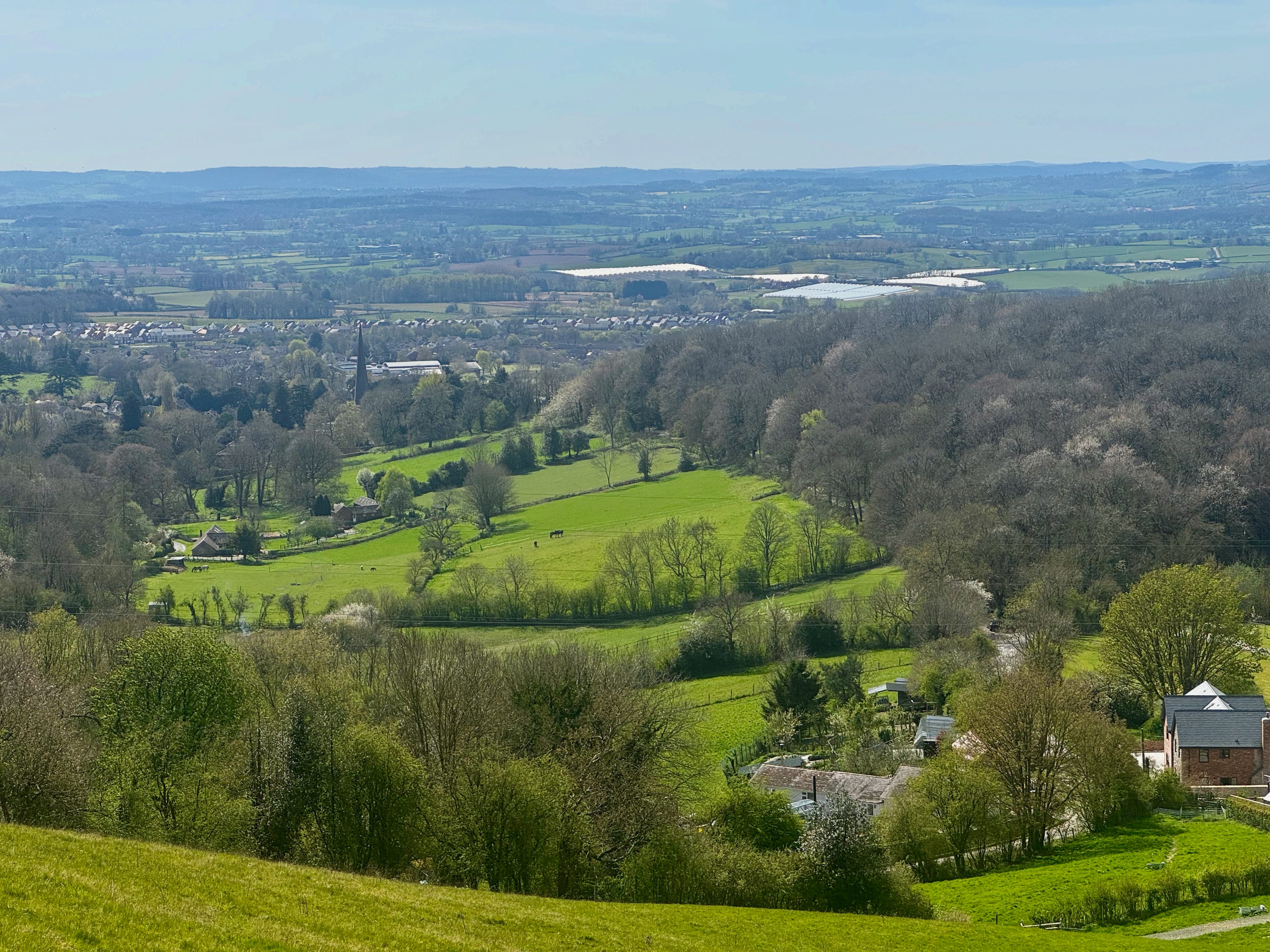
Looking down onto Ledbury - Adam Cairns, 2026
The move itself was quieter and gladder than any move I’ve made. I had been coming to Ledbury for years before I lived in it — for the poetry, mostly, and the poets, who were friends before they were neighbours — so that arriving to stay felt less like landing among strangers than like finally admitting where I already belonged. It is an odd, undramatic feeling, belonging. It arrives without ceremony. But I notice it more each week, and I notice it most standing at this fence, which is perhaps why the heat and the meadow have got so thoroughly mixed up in my mind with the question of home. I have found, late, a place I want to keep. And I have found it just in time to understand that keeping it means keeping more than the house.
I don’t know how to end an essay like this without lying in one of two directions — either into despair, which is just brooding with the lid down, or into the brisk false comfort of ten things you can do before Friday. Neither is honest, and neither is the practice this newsletter has been feeling its way toward. The practice is smaller and harder than both. It is attention: the willingness to stay with what is in front of you and not look away — the ash-coloured ground, the panting blackbird, the field that used to hold a bird it no longer holds. It is the same discipline poetry asks for, the refusal to let the thing become a symbol of something more flattering, and it turns out to be a moral discipline as much as an aesthetic one. You cannot care for what you have not first consented to notice. The web becomes visible only to the attention that slows down enough to see it, and it is only once it is visible that leaving the light on in the empty room starts to feel like the choice it always was.
So I look at the blank green square that is my garden, and for the first time I am glad it is blank. A patch of new turf and nothing else is not an absence; it is an invitation. I can let a corner of it go feral and loud. I can plant it toward the meadow rather than fence the meadow out. I can put a swift box under the new eaves for birds that may or may not find it. None of it is equal to the size of the problem. All of it is a way of making a home that keeps faith with the web it sits inside, rather than one that merely takes its view and shuts the gate.
This evening the heat has come off the day at last, the fields going blue and soft at the edges, the oxeye daisies turning grey and then invisible in the dusk. High up, later than I expected, there were swifts — not many, a loose handful, screaming round the new roofs the way they have every July of my life. I stood at the fence between my blank canvas and the crowded meadow and watched them until I lost them against the dark, and I made myself do the harder thing, which was not to turn them into a hope or a warning or a line, but only to see them: alive, and here, and not yet alone. Screaming. Feeding on the warm air. Holding, for one more summer, their small end of the thread.
Much to think about here, Adam, thank you
Gosh Adam. Superb… and I am ‘brooding’ too. I miss you. I’m doing a lot of ‘’long view’ thinking and working out how to be a ‘good ancestor’. I will be in touch. Hugs from the Auvergne. Lynette