

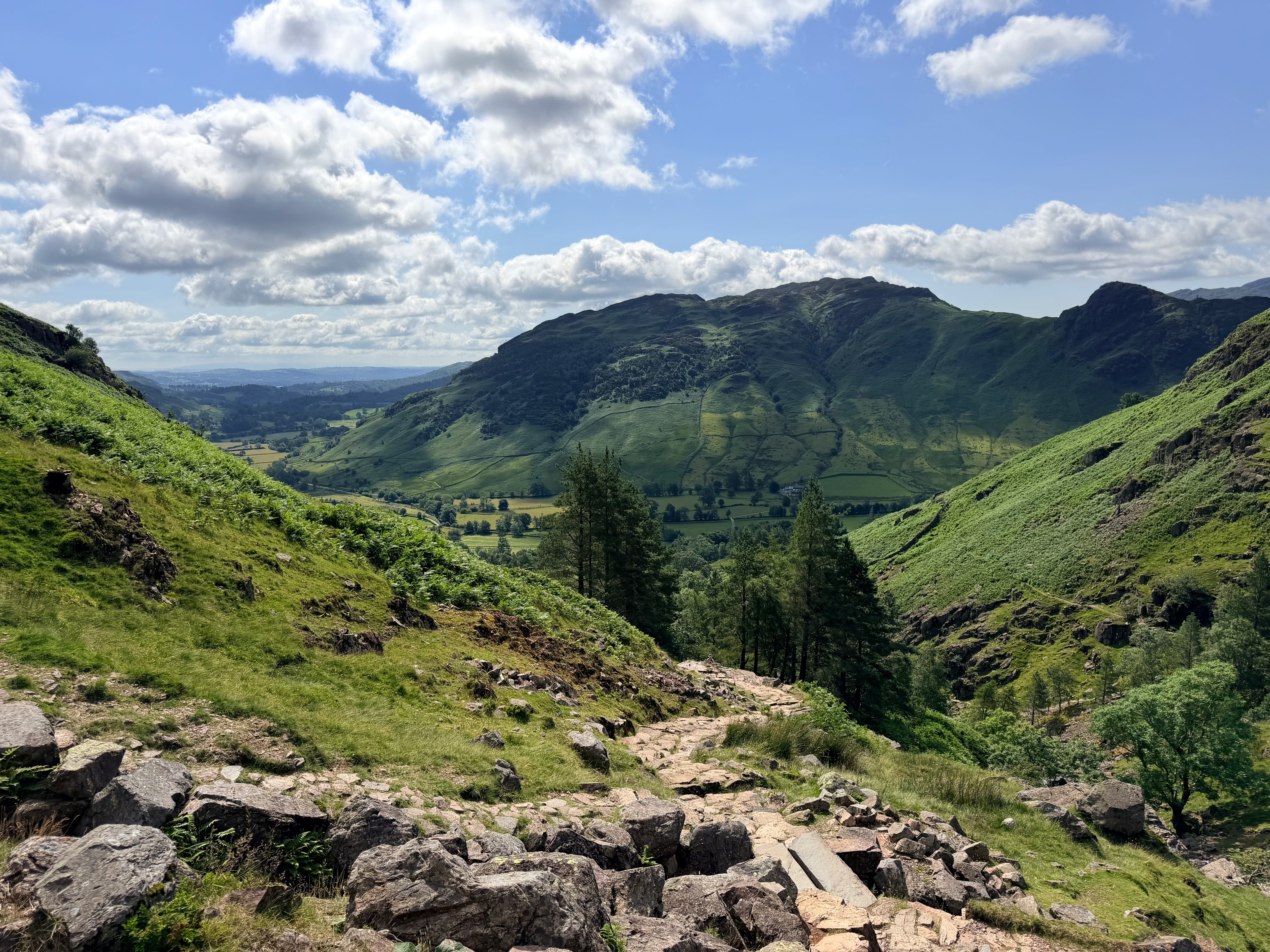
Half-way up the Langdale Pikes, Adam Cairns, 8th July, 2026
I am writing this from the Lake District, a few days of borrowed time among the fells — the bracken high and greening over, the becks still loud after June’s rain, the light not properly gone until well past ten and the valley going that deep slate-blue that isn’t quite dark. Walk out late enough, away from the village, and the sky here does the thing it can no longer do over most of England: it fills, edge to edge, with stars. Which is roughly how this fortnight’s three arranged themselves — a poet, a painter and a composer, each caught in the act of looking up, and each finding that to be alone under that much sky is not at all the same as being lonely.
1. A poem to enjoy — William Wordsworth, “A Night-Piece” (1798) — You cannot walk these fells with a book in your pocket and not have it be Wordsworth’s; he is the presiding spirit of the whole district. This poem is the one I always remember on a dark-sky night. A “pensive traveller” is treading a “lonesome path” with his “unobserving eye / Bent earthwards” — head down, going nowhere in particular — when the cloud splits and “above his head he sees / The clear Moon, and the glory of the heavens,” the “multitudes of stars” wheeling in their vault. Nothing is added to the man; something is simply uncovered above him, and it changes the walk. It is the plainest account I know of what solitude is actually for: not withdrawal, but the clearing of the eye until more of the world can get in.
2. Art work of the week — Caspar David Friedrich, Two Men Contemplating the Moon (1819–20), Galerie Neue Meister, Dresden — Two figures stand with their backs to us at the edge of a wood, the one leaning on the other, watching a thin crescent moon and, just trailing it, the evening star. Friedrich paints them from behind on purpose, so that we stand where they stand and look where they look. It is the exact companion to the Wordsworth: solitude, but shared — two people alone together under an enormous sky, which is perhaps the truest picture of this publication’s title I have yet found. The older figure is thought to be Friedrich himself; the younger, his pupil August Heinrich, dead at twenty-eight only two years after it was painted. Even the stars here are kept company.
3. Music to sit with — Max Richter, “To the Stars,” from the Ad Astra soundtrack (2019) — Richter wrote the score for James Gray’s film about a man who travels to the outer edge of the solar system in search of his lost father — about the loneliest journey the movies have imagined in years — and “To the Stars” is its opening breath: slow strings, a wash of electronics, and, woven into the fabric of it, actual signals transmitted home by the Voyager probes still drifting past the planets since the 1970s. It is the same gesture as the poem and the painting, scaled up to the cosmos: the small self under the vast dark, and the discovery that the dark is not empty but full of signal. Put it on late, with the lights off. Per aspera ad astra — through hardship to the stars.
A question for you — when did you last stand somewhere dark enough to see the whole sky? Not a glimpse between streetlights, but the real vault, stars down to the horizon. Where were you, and what did it do to you? Reply and tell me — I read every one.
A thought from me — the name of this publication is Beyond Solitude, and I have spent time this week walking these fells, trying to say what the beyond is. I think these three have said it for me. Wordsworth’s traveller, Friedrich’s two friends, Richter’s voyager: each is as alone as a person can be, and each finds that looking up is not an escape from the solitude but the far side of it — the point where being by yourself opens out into being among everything. Solitude isn’t the opposite of connection. Entered properly, in a quiet enough place, it is the way in.
— Adam
Friedrich is the magician of solitude.