

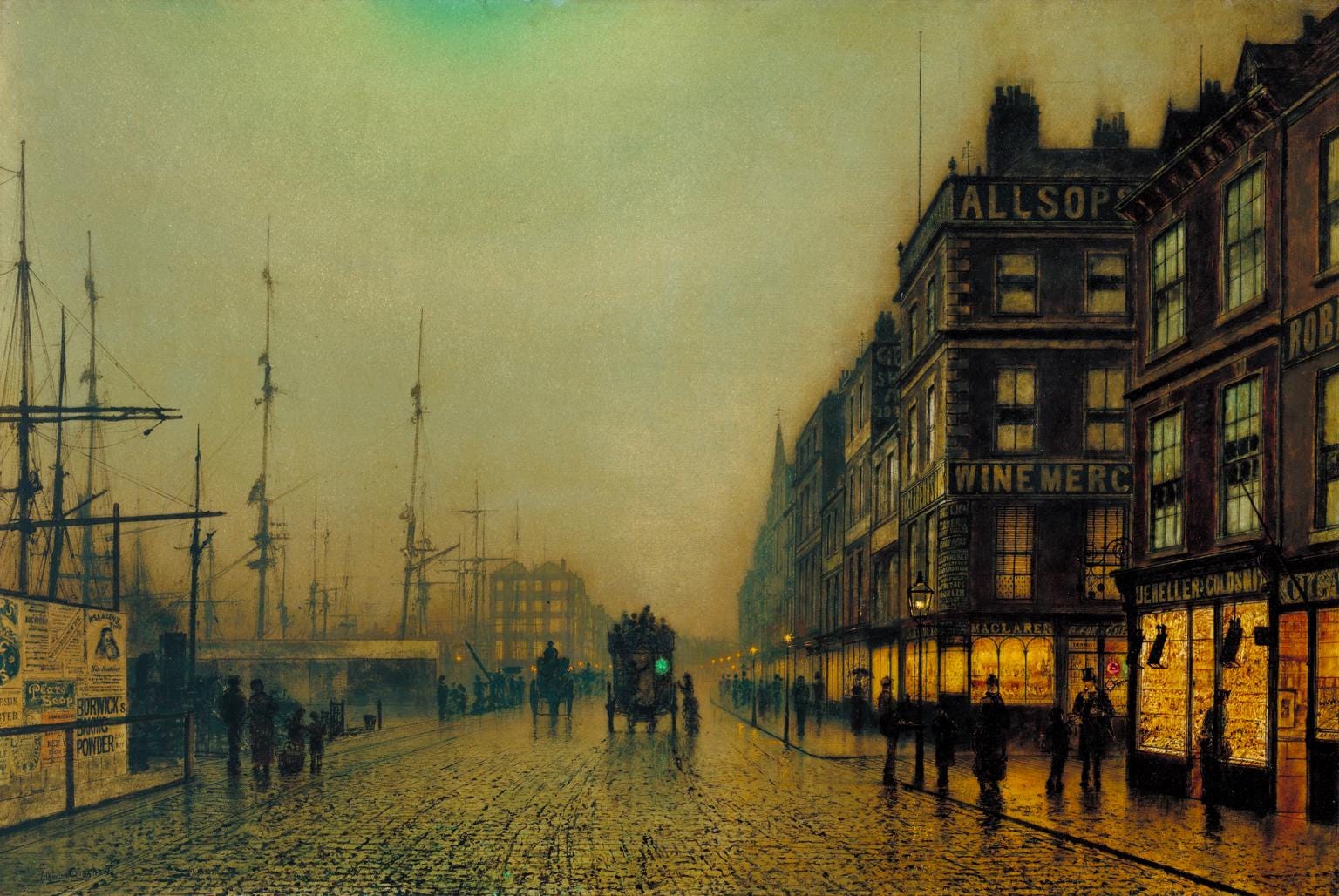
Liverpool Quay by Moonlight, 1887, Atkinson Grimshaw
It’s late Autumn now, and in Herefordshire that means the orchards are being picked, there might be a first frost and the clocks have just gone back. It’s always a shock to find the evenings suddenly darker, and I have an urge to withdraw into the lamplight. Alone perhaps, but I don’t feel isolated. The streetlights are on, there are friends along the road.
1. A poem to enjoy - Thomas Hardy, During Wind and Rain (1917)
Hardy draws on the material he found in Some Recollections, the book he found ‘bound in brown paper, made from the pages of exercise books and stitched together with red thread.’ This home-made book was written without Hardy’s knowledge by his wife, Emma and he only discovered it after her death.
Each stanza shows a family scene full of life (singing, clearing the garden, taking breakfast outside, moving house), and each time Hardy turns to the refrain: ‘Ah, no; the years’.
The refrain is followed by one more line, each one worse than the last: the leaves, the storm birds, then the rose torn from the wall, then rain running down the carved names on the headstone. That build toward the grave drives the poem.
I love this poem because like all successful elegies, Hardy never refuses the happiness he records.
2. Art work of the week — Atkinson Grimshaw, Liverpool Quay by Moonlight (1887), Tate
Grimshaw painted the hour we get when the clock goes back at this time of year. Wet cobbles, gaslit shopfronts, the ships’ rigging against the sky, people hurrying home.
In the painting, the people are held together by the warm light spilling onto the street, that glow from the shop windows is companionable. They step into the gathering dark, then find they share it with others. Solitude works that way too. It’s a place you go into and the lights stay lit for when you come back. The painting would not carry the same emotional weight without the reflected light on wet stone.
3. Something happy — Apple Day, 21 October
Common Ground started Apple Day in 1990 to celebrate local varieties and orchards. Herefordshire is cider country. It’s often a small gathering, where there is pressing, tasting, and naming of the old varieties as well as music, crafts and games, including apple bobbing, and the longest apple peel competition.
I celebrate Apple Day on the walk I do that leads up the hill to Frith Wood. The hillside holds a small orchard and I walk through it each time I make my way up that hill. A green woodpecker lives there, and if I’m careful I catch sight of it on the ground among the fallen fruit. At other times all I hear is its manic laughter in the distance as if it might have eaten too much fermented fruit.
As I walk among the turning leaves and scattered fruit, I realise that orchards display what the year leaves for us to gather in our hands.
Apple Day runs throughout October.
A question for you
October is the month when summer shifts into the shadow of winter and there is a colour and mood that accompanies it. I also notice a series of subtle shifts in my behaviour. For instance, I find myself opening cupboard doors with an urge to tidy them. My food shopping shifts too, with more root vegetables and soup on the menu.
What do you do with the first dark evening after the clocks change?
A thought from me
Hardy’s refrain, Grimshaw’s lit windows spilling light on wet cobbles and the apples gathered and stored for the winter all tell us that while the year is taking away the light, it is also a time when you can see what you have gathered.
I’m spending more of my days indoors now, but as I walk up the lane to my house to come in from the chill or the rain, it’s a choice I’m happy to make.
I haven’t written one of these for a while, and it’s an object lesson in the power of routines. Towards the end of the summer, I needed a break and gave myself one. No more articles - for just a couple of weeks. And here we are, almost three months later.
Adam